


Classes





Bard - Deep Dive
Overview
A common question after the initial Bard direction post seemed to be, “What exactly is the Bard’s role?” So, let’s begin by clearing that up. Bard is a versatile support class who focuses on supplying buffs that stack with other classes' signature buffs, crowd control, and pulling. The design of the bard forces them to choose just a few of the support facets they can provide at any one time, via their memorized songs, the songs they are actively maintaining, and the instrument they have equipped (and therefore the played songs that get amplified).
This update focuses on easing the amount of work required just to maintain buffs, increasing the variety of songs they have access to, and giving them a means to add damage to a group without maintaining a charmed pet. While instrument swapping is not directly addressed, the new casting mechanic and wielding style will hopefully reduce how often you feel obligated to do so, and this may see further iteration in the future.
Stat Changes
Charisma is now used to determine bard mana, as well as damage bonuses on songs. It would apply to healing as well, but Bards currently lack any such spell. Hymn of Restoration is a Health Regeneration stat buff, not an actual heal.
Skill and Wielding Changes
Bards no longer have access to the Dual Wield skill. While visually and thematically we tend to think of bards as capable of wielding a pair of fast weapons, the mechanics of the class are better suited to wielding a single weapon with an instrument in their off hand. Bards now gain the Double Attack skill at the same levels and caps they previously had Dual Wield.
Bards have lost the Channeling skill. This did nothing for them anyway, as their songs can only be interrupted via a stun.
Bards have also lost the Meditation skill. The vast majority of their spell lineup requires zero or minimal mana, and few Bards have the time to sit and do nothing anyway. With the changes to their casting mechanic, there’s a bit more incentive (or at least time) to use their Shout abilities, and these will need to applied strategically to make the best use of their mana.
Casting Mechanics
Bard songs which buff themselves or the group will now remain active after casting them and auto refresh after casting a new song. This has always worked this way for the most recent song, but bards are now able to maintain multiple. Initially, bards will play in “Cut Time” and maintain a 3 song Measure. At level 30, bards unlock the “Common Time” trait, adding a song to their Measure allowing them to maintain 4.
When you play another beneficial song and are already at capacity, the oldest song will stop being maintained and fade off quickly after. Alternatively, you can stop one of the active songs by using that ability, and start a new one without pushing the oldest out.
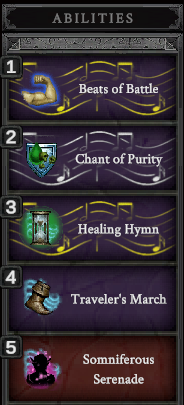
Your actively maintained songs are shown on the Ability Bar, with the most recently cast song highlighted in white.
When you cast a targeted or detrimental song, you’ll push a song out of your queue, and only the most recent song will be refreshed automatically. You’ll need to twist (sequentially recast the songs) to maintain multiple detrimental songs, or a combination of buffs and detrimental songs.
When not needing to actively recast songs to maintain buffs, you should have a bit more time to use the new melee ability, or your Shouts, which can be used while the songs in your Measure stay active.
Instruments
Instruments have been greatly increased in strength, with basic store-bought versions now adding a 50% bonus to applicable songs. All existing instruments have had their bonus value reviewed and set on this new scale. Healing Hymn and Hymn of Inspiration have had their base values adjusted as a result of the new scale for instrument bonuses. The instrument types for some songs has changed in this rework.
Instrument bonuses currently apply to the following spell types:
Stat bonuses other than Haste (including Movement Speed and Health Regeneration)
Damage Absorption Effects
Mana over Time (Hymn of Inspiration)
Damage and Damage Over Time (DOT)
We hope to see more spells impacted by instrument quality in future patches.
Melee Ability
Bards gain a single melee ability, Whistling Blade. This attack does modest damage, but applies a Strength buff. At higher tiers, this buff adds Armor Class and Haste (Primary). While this has no casting time, it does apply a short global cooldown and isn’t best used when frantically twisting your songs.
Shouts
Shouts are mana-consuming instant cast abilities Bards can use while maintaining songs, or between songs they are twisting. You cannot use a Shout during the 3 second cast time of a song.
Bards retain all their current shouts:
The Screaming Vocalization DD line
Repel, an area effect de-taunt
Frightful Screech, the targeted fear
The Mesmerizing Whisper line of short duration mezzes
They gain one additional shout:
Paralyzing Shriek - Release a paralyzing shriek, stunning foes around you for 3 seconds
Songs
Songs are the bread and butter of the Bard toolkit, and are either twisted or multiple songs can be maintained in a set of active songs called a Measure. In this rework, some songs may have changed their Instrument type. Each Instrument type has at least one song that scales numerically with the quality of the instrument.
Charm
The Siren’s Call line of Bard Charm songs has received a few changes:
Only Beasts and Humanoids can now be charmed
Charms no longer have a chance to break when damaged
The Damage of Charmed NPCs is now reduced to be on-par with the damage of a dedicated pet class’ pet.
Mesmerization
Somniferous Serenade is now a Wind instrument song, but is otherwise unchanged. Mesmerization songs now handle overwrites based on duration, making it easier to work with an Enchanter to replace short lasting Bard mezzes with longer lasting Enchanter versions.
Damage over Time songs
The Dissonant Riffs line has been removed. This line included 5 songs that stacked, but it wasn’t obvious to all players that they could be used together and stack, and were often misinterpreted as upgrades that had the numbers or descriptions set wrong.
The new Vellicosa’s Fanfare line features two Brass-based magic DoTs that specifically call out in their description that they stack together. The higher level one, Vellicosa’s Tantara, adds bonus damage when the target is already affected by Vellicosa’s Fanfare. The total damage of these two songs is an upgrade over the total of the previous 5 DoTs - this is strictly an upgrade.
Haste Songs
These songs have been renamed to be more easily understandable by players that are not real life musicians, but are otherwise unchanged. In addition to their Primary Haste songs, Bards continue to offer top-tier Secondary Haste, allowing them to further buff groups that already contain an Enchanter or Shaman.
Resist Songs
Resistance buffs are an area the now Bard excels at. The previous two Magic Resistance songs that mimicked resistance buffs other classes get have been replaced with 4 scaling buffs that can be further improved based on your equipped Percussion instrument:
Chant of Magic Protection - provides 5 to 10 Magic Resistance before the instrument bonus
Chant of Purity - provides 5 to 10 Poison and Disease Resistance before the instrument bonus
Chant of the Elements - provides 5 to 10 Fire, Cold, and Electric Resistance before the instrument bonus
Chant of Neutrality - provides 5 to 10 Holy and Corruption Resistance before the instrument bonus
Bard resistance songs stack with resistance buffs provided by other classes.
Other songs
While versatility is a defining aspect of the Bard, the existing songbook was rather sparse, and this rework beefs that out with some new song types. Expect to see a few more show up in the future.
Beats of Battle - Beats of War has been moved to a higher level and the low level version replaced with this more modestly named version. Beats of War is an upgrade to Beats of Battle.
Aristam’s Steady Tread - Not every situation allows for the full speed of Bard’s Song of Travel, and Steady Tread fills the gap when a Bard finds themselves deep in a dungeon. The song offers a modest base run speed increase and the option to push that a bit further with an equipped drum.
Disenchanting Blare - A targeted Brass song to remove harmful effects from your party members.
Discordant Purge - The complementary song to Disenchanting Blare, this song dispels beneficial effects on your targeted foe.
Tembror’s Booming Bravado - Amplifies the voices of your groupmates, giving them a chance to fully resist Silence effects
Aristam’s Aerial Aria - This airy tune slows the descent of your group. While not making them immune to gravity or falling damage, it will decrease the rate at which they fall. Expect a pass on these levitate effects in the future to make them a bit safer, and use with caution for now.
Aristam’s Voluminous Voyage - This high level Percussion song combines the effects of Song of Travel, Sonnet of the Unseen, and Aerial Aria for the ultimate in bard travel.
Faedawyn's Piping of Protection - Weave a mail of musical protection around your group, increasing their Armor Class and absorbing incoming damage.
Anthem of Restoration - This high level upgrade song combines the effects of Healing Hymn and Hymn of Inspiration.
Retained Songs
Bards retain the following songs that haven’t been previously mentioned:
Healing Hymn
Traveler's March
Selstie's Aeolian Aria
Hymn of Inspiration
Sonnet of the Unseen
Harmony of Visions
Cooldowns
Bards gain one new long cooldown ability:
Crescendo - Raise your song in a mighty crescendo, increasing your Instrument bonus with all Instruments, as well as Singing.
Closing
That wraps it up for this Bard update. We’re looking forward to seeing all you future Bards when Early Access opens up!

Archer - Bard - Beastmaster - Cleric - Druid - Elementalist - Enchanter - Fighter - Inquisitor - Monk - Necromancer - Paladin - Ranger - Rogue - Shadow Knight - Shaman - Spellblade - Wizard